# Lead Form

Lead Form in Chat Widget is a workflow to capture visitor information in case you a visitor want to leave their contact details.

Once a visitor submits their contact details, the system will email you with contact information and a link to visitor interactions.&#x20;

### Configure Lead Form

To enable the lead form in your widget, navigate to your Widgets -> Chat Widget. Click on the tab for Lead Form and enable the form. Once you enable the form, you will need to complete the following details

* Required -> If you want visitors to fill in the lead information after their first interaction with the chatbot, enable this. If not, visitors can keep interacting with the chatbot, even without entering their contact details
* Intro Message -> A message for visitors to understand why they need to share their contact details
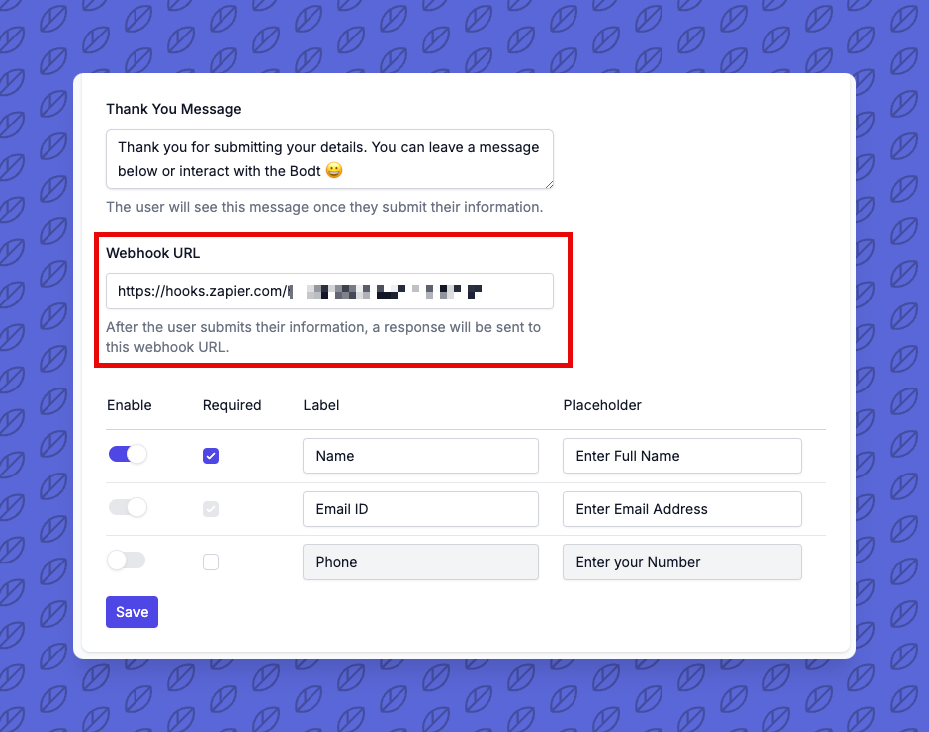
* Thank You Message -> A message that is shown to the visitors once they submit their contact details
* Webhook URL -> You can integrate the lead capture form with third-party services like Zapier to capture lead information into your CRMs. You can enter a URL where the system will send lead information.&#x20;
* Data Fields -> You need to enable what all fields need to be captured in the lead form.&#x20;

### Zapier Integration

You can integrate the lead form into Zapier and potentially integrate it with any compliant application. You will need to&#x20;

#### Create a new Zap

You start by creating a new zap from your account. You can do so by clicking on the "Create" button in the sidebar, after login to your account.&#x20;

<figure><img src="/files/MJAmYWAvPGeBChCGuHnF" alt=""><figcaption><p>Create a new zap for Bodt Integration</p></figcaption></figure>

#### Add Steps to Zap

To build a zap, you need to create multiple step in the step. Each step defines what action will that zap take when executing your requests.&#x20;

<figure><img src="/files/UG6nxxYath6Oze13rHqx" alt=""><figcaption><p>Create actions in zaper</p></figcaption></figure>

#### Catch Hook Step

The first step in your zap should be a "Webhook by Zapier" step. This is required so that your Zap can receive data from the Bodt app. &#x20;

You will receive a webhook URL when you set up this action. This webhook URL will be saved within your widget setting to share data.&#x20;

<figure><img src="/files/WzeIMv8VZKN2oVqri8gf" alt=""><figcaption><p>Choose Webhook by Zapier as First Step</p></figcaption></figure>

<figure><img src="/files/k9LN0szcG0MDRB5J22Mb" alt=""><figcaption><p>Setup webhook step</p></figcaption></figure>

<figure><img src="/files/JfbLzs4NtXz9L4UKbiOY" alt=""><figcaption><p>Webhook URL</p></figcaption></figure>

#### Save the webhook URL in the widget

You need to save the webhook URL from the above screenshot into the widget lead form webhook URL.&#x20;

<figure><img src="/files/NBBvxwD2aoo68my0mx59" alt=""><figcaption><p>Configure webhook URL in widget setting</p></figcaption></figure>

#### Integrate with any other app

As a next step, you can now integrate the data received from Zapier into any other action available on the platform. For eg. you can connect the incoming lead data into the CRM like Hubspot, Pipedrive, etc. You can also save the incoming lead data into a Google sheet or send an email.&#x20;

<figure><img src="/files/qHMlRGeO9AXFtoyUxDcO" alt=""><figcaption><p>Integrate the incoming data from Bodt into third party zapier apps</p></figcaption></figure>


---

# Agent Instructions: Querying This Documentation

If you need additional information that is not directly available in this page, you can query the documentation dynamically by asking a question.

Perform an HTTP GET request on the current page URL with the `ask` query parameter:

```
GET https://docs.bodt.io/chat-widget/lead-form.md?ask=<question>
```

The question should be specific, self-contained, and written in natural language.
The response will contain a direct answer to the question and relevant excerpts and sources from the documentation.

Use this mechanism when the answer is not explicitly present in the current page, you need clarification or additional context, or you want to retrieve related documentation sections.